
The 5-step roadmap to Industry 4.0 for UK manufacturers — without the buzzwords
Most Industry 4.0 roadmaps are written for an audience that does not exist: an SME manufacturer with unlimited budget, infinite time and no operational fires to fight. This one is written for the real audience — a UK ops director, engineering lead or CEO who has 18 months and a board that wants visible payback.
The roadmap most consultancies hand you doesn't survive contact with reality
The standard Industry 4.0 roadmap, as it is usually drawn, has nine workstreams, a four-year horizon and a colour-coded slide that reads like an architecture diagram. It does not survive contact with a board meeting where the finance director wants payback inside two years and operations is busy keeping the line running through the summer.
What works in practice for UK mid-cap and SME manufacturers is shorter, sharper, and built around a small number of decisions that have to be made in the right order. Five steps. Each one shipping something tangible. Each one buying the credibility and the financial headroom to fund the next.

A real Industry 4.0 roadmap is built around five sequenced decisions, not nine parallel workstreams.
"A good Industry 4.0 roadmap is one where every step is allowed to fail without taking the whole programme with it."
Why a phased roadmap matters more in 2026
UK manufacturing operates on tighter margins, with shorter customer lead-time expectations and higher input costs than at any point in the last decade. The Department for Business and Trade's Advanced Manufacturing Plan sets out the national direction, but it does not write your investment sequence for you. Made Smarter UK is funding adoption at SME level, and the case studies from the programme repeatedly show the same pattern: the manufacturers who get a return are the ones who phased their investments, not the ones who tried to do Industry 4.0 in one big bet.
Internationally, the World Economic Forum Global Lighthouse Network — the 150+ factories around the world recognised for genuine Industry 4.0 maturity — show the same thing. None of them got there in one programme. All of them did it in sequenced phases over three to five years, with visible business value at every step.
The roadmap below is that pattern, adapted for a UK SME context, with no buzzwords.
The 5 steps, in the order that actually works
Step 1 — Diagnose, in numbers, where the business is leaking value (4 to 8 weeks).
Before any technology decision, run a structured diagnostic of where your operational and engineering value is leaking. Lost throughput. Quality cost. Unplanned downtime. Engineering change lead time. Order-to-cash cycle. Inventory tied up in WIP. Each one quantified, each one with a baseline, each one with a credible "what would good look like?" target. This is not a SWOT exercise. It is the financial case for everything that follows. If a step in the roadmap cannot be tied back to a number on this diagnostic, it does not get funded.
What the leadership conversation looks like: "We thought our OEE was 78%. Measured properly, it is 61%. The 17-point gap is worth £1.4M a year. That is the budget envelope for everything we are about to discuss." Honest. Numerical. Uncomfortable. Necessary.
Step 2 — Build the digital backbone before you optimise anything (3 to 6 months).
The single most common mistake in UK Industry 4.0 programmes is going straight from diagnostic to point-solution — "we need an MES", "we need predictive maintenance", "we need a robot on line 3". Skip the backbone and every point-solution becomes a silo with its own data and its own truth.
The backbone is the connected layer that lets every subsequent investment talk to every other one: PLM as the single source of engineering truth, MES as the single source of production truth, IIoT and historian as the source of equipment truth, and integration to ERP for the financial layer. You do not need to deploy all of it in Step 2 — but you need to have chosen the platforms, defined the integration model, and shipped the first meaningful slice into one cell or product family.
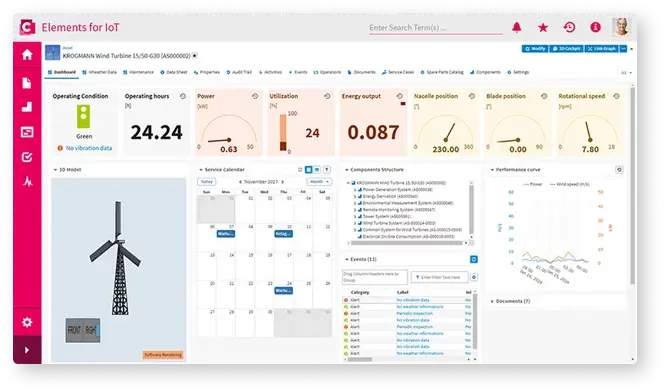
The smart factory connects engineering, production, equipment and finance — the backbone of every Step 3 investment.
Step 3 — Use the backbone to ship targeted operational wins (6 to 12 months).
Now the point-solutions can land safely, because they plug into the backbone instead of becoming new silos. Live OEE dashboards from real machine data. Engineering change orders flowing from PLM straight onto the operator terminal. Quality data captured at the point of work, feeding back to engineering. Predictive maintenance triggered from real condition data. Each one a discrete project. Each one shipping in 8 to 12 weeks. Each one with a financial benefit traceable back to Step 1.
This is the phase where the programme moves from "investment" to "return." And critically, it is the phase where the operational team starts to trust the digital programme, because the digital programme starts to make their day easier.
Step 4 — Layer in automation, robotics and analytics where the backbone says they belong (12 to 24 months).
By Step 4, you have a quantified diagnostic, a working digital backbone, and live operational data telling you exactly where physical automation, robotics or advanced analytics would pay back. Now — and only now — you can scope automation investments against real numbers rather than vendor brochures. You can commission a cobot or a vision inspection rig and know within 30 days whether it is performing, because the underlying systems already measure it. Predictive analytics has clean historical data to learn from. AI tools have a structured data pipeline to plug into.
The reason most automation investments under-deliver is that they happen in the wrong order — before Steps 1, 2 and 3. In sequence, they compound.
Step 5 — Scale across the plant and the supply chain (Year 2 onwards).
The final step is replication and reach. The pattern that worked for one product family extends to the next. The visibility that worked for one site extends to the others. The data that was useful inside the four walls of the factory starts being shared with key suppliers and customers. The digital thread, which sounded abstract in Step 1, is now real: engineering change to production handoff to as-built quality record to customer-facing service data, all connected.
Year 3 and beyond is where the lighthouse-network factories operate. Most UK SMEs never get there because they tried to start there. Sequence the first four steps properly and Step 5 becomes the natural place you arrive, not the place you aspire to.
What changes at each step — for leadership, for operations, for the board
The roadmap is only half of the answer. The other half is what changes in the organisation at each step, because every step demands a different leadership conversation.
Step 1 is a finance and operations conversation. The output is a number. The leadership commitment is to act on what the number says, even when it is uncomfortable.
Step 2 is a strategic IT and architecture conversation. The output is a chosen platform stack and an integration model. The leadership commitment is to fund the backbone before the visible point-solutions, even though it does not produce immediate shop-floor value.
Step 3 is an operational adoption conversation. The output is live, used, trusted dashboards and workflows on the shop floor. The leadership commitment is to back the change-management work — training, shop-floor champions, recognition — that turns deployed software into used software.
Step 4 is a capex conversation, but a smarter one. The output is automation and analytics investments with measurable returns inside 30 to 90 days. The leadership commitment is the discipline to say no to investments that the backbone cannot yet support.
Step 5 is a strategic and commercial conversation. The output is a manufacturing capability that compounds over years and shows up in win rates, gross margin and the quality of the customer relationships. The leadership commitment is patience.
A UK precision engineering business we worked with started this roadmap with an OEE diagnostic that revealed they were 19 points below where they thought they were. Step 2 (PLM-MES backbone for one product family) took five months. Step 3 (live OEE, electronic work instructions, quality at source) shipped in three sprints over the following nine months and recovered 9 OEE points in the first year. Step 4 (a vision inspection rig and a predictive maintenance pilot) followed in Year 2, with payback verified inside 90 days because Step 2 had made the measurement possible. Step 5 is now in motion across their other two sites. The whole programme is paying for itself out of recovered throughput.
What we would tell you if we were sitting across the table
Eight practical disciplines that separate the manufacturers who reach Industry 4.0 from the ones who only ever talk about it.
 Start with a numerical diagnostic, not a vendor demo.
 Every funded step has to trace back to a measured value leak.
Fund the backbone before the point-solutions. PLM, MES and IIoT integration is not exciting on a slide. It is the difference between scalable progress and a silo museum.
Ship Step 3 in quarterly cycles. Each operational win has to land in a single quarter or it loses organisational momentum.
Use the 30-day rule on every Step 4 investment. If you cannot measure the benefit in your systems within 30 days of go-live, defer the investment.
Name a business co-leader alongside the IT lead from Step 2 onwards. The single biggest predictor of whether the programme pays back.
Treat change management as a workstream, not an afterthought. Adoption beats deployment every time.
Refresh the diagnostic every 12 months. The value leaks shift as the early steps land. The roadmap has to follow them.
Apply for the funding you are entitled to. Made Smarter UK, Innovate UK and regional growth hubs all offer co-funding for the right kind of programme. Build the application into Step 1, not Step 4.
The bottom line
Industry 4.0 is not a single programme. It is five sequenced decisions, each one delivering measurable value before the next is funded. The roadmap above is the pattern we see work consistently for UK SME and mid-cap manufacturers: diagnose in numbers, build the digital backbone, ship targeted operational wins, layer in automation against real data, scale across the plant and the supply chain.
The manufacturers who reach lighthouse-level maturity in 2030 are the ones who started this sequence in 2026. The ones who waited for a tidier plan, a bigger budget or a quieter year are still going to be planning when their competitors are scaling.
Coming soon — The TJ Manufacturing Interview Series. Tim Shelley in conversation with Gavin Hill, Head of Information Management Research at the AMRC, on what the UK's roadmap to advanced manufacturing actually looks like from the research front line — and where the biggest opportunities are for companies willing to act now. Get notified when it launches →
Want to know which step you are really on?
Our half-day Manufacturing Diagnostic puts a number on the value you are leaking, identifies which of the five steps you are realistically ready for, and gives you a costed Phase 1 plan to take to your board.