
Electrification Academy Partnership
Independent Subject Matter Expert for Battery Cell Manufacturing at Electrification Academy — the B2B platform connecting battery engineers with vetted vendors, equipment suppliers and domain experts.
How it started: Barcelona, September 2024
The Excellence in Battery Manufacturing Processes, Regulations and Technology of Battery Cells and Systems forum, September 2024, Barcelona. Dr. Veronika Wright was presenting on Data & AI for circular-economy principles in battery manufacturing. I was there to sense-check what was happening on the production lines I was advising on. The conversation that followed her talk did not stop for the next 20 months — and within a few weeks of meeting, the foundation of my work with Electrification Academy was in place.

Excellence in Battery Manufacturing forum 2024
Battery cell manufacturing has a discovery problem
If you have spent any time inside a cell manufacturing programme, you will know the pattern. The engineering team is wrestling with a coating-and-drying ITT, qualifying a new mixer, sense-checking electrode designs against downstream cell performance, or trying to get formation and ageing to behave at scale. They need a specific answer to a specific problem. What they get back, more often than not, is a vendor spec sheet, a glossy capability deck, and a sales call.
The depth of expertise exists across the battery and electrification value chain. It just is not organised around the way an engineer actually works. By the time the right person is found, the decision is already made, the line is already half-built, or the budget has already moved on. That is the problem Electrification Academy was built to solve, and it is the gap I have been working to close from the cell manufacturing side over the last 20 months.
"The depth of expertise exists. The problem is finding it in the context of the problem you are actually trying to solve."
The Electrification Academy platform, built around real engineering workflows
Electrification Academy is a B2B knowledge platform connecting OEMs, engineers and technical decision-makers across the battery and electrification value chain with vetted vendors, equipment suppliers, and domain experts. Rather than acting as another industry directory, the platform organises solutions around the actual workflows engineers face — from electrode coating and drying through cell assembly, formation and module integration — so teams can find the right technology and expertise in the context of the problem they are trying to solve.
The work I do as the Independent Subject Matter Expert for Battery Cell Manufacturing is to keep that workflow-first principle honest end to end: the terminology engineers use, the trade-offs that matter at ITT, the equipment classes that genuinely belong next to one another, and the integration realities that decide whether a pilot line ever becomes a scalable production environment.
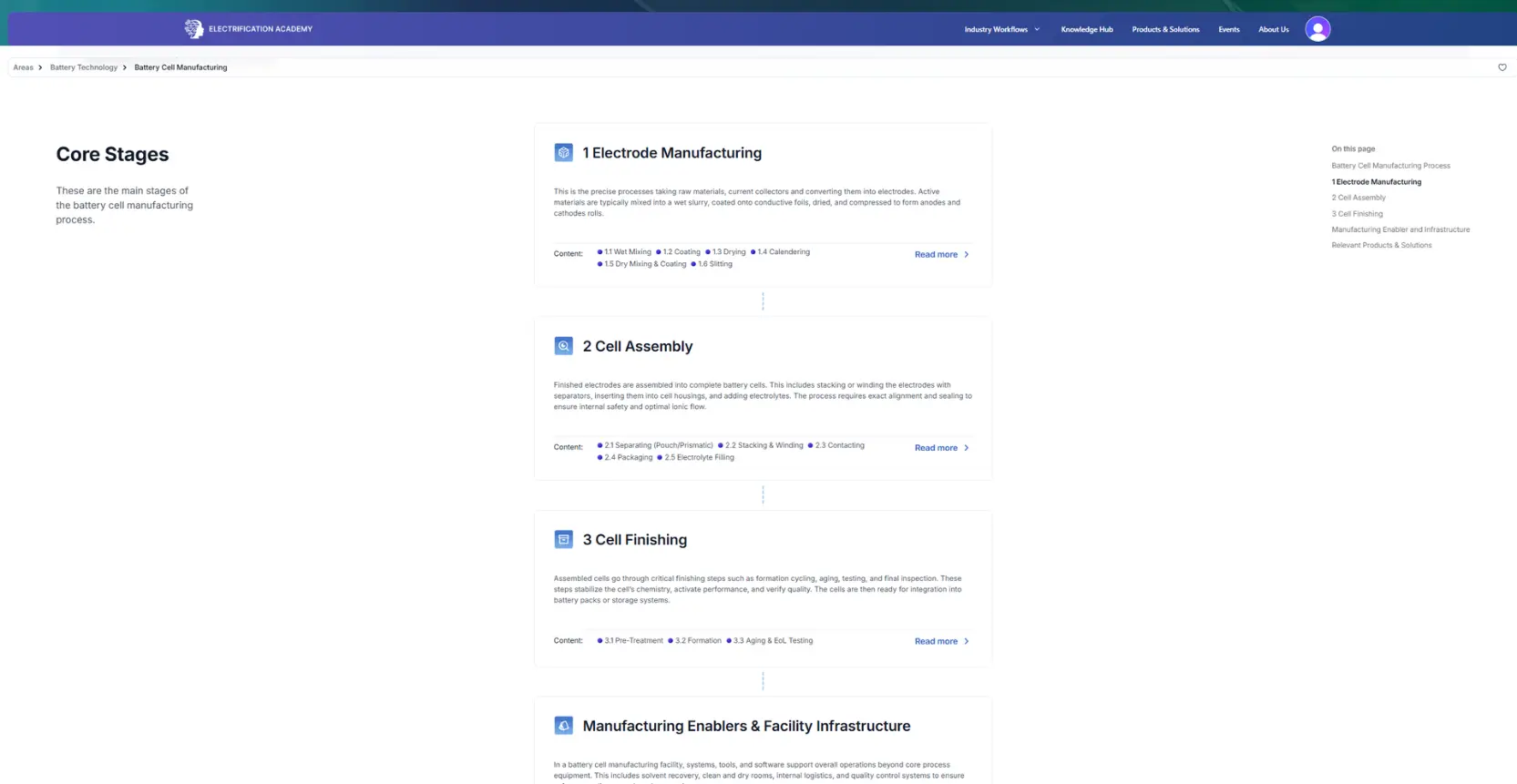
The Battery Cell Manufacturing area of Electrification Academy — workflow-first navigation across mixing, coating, drying, calendering, slitting, assembly, formation and module integration - link
Where my work sits across the battery cell manufacturing process
Cell manufacturing is a chain. A bad decision upstream shows up — expensively — three process steps later. Most of what I contribute to the Battery Cell Manufacturing area of the platform is making those linkages visible, so engineers can see how a choice in mixing or coating cascades into yield, cost and quality further down the line.
Electrode mixing and slurry preparation. Slurry rheology, solids content, dispersion quality and batch-to-batch repeatability are the first things that decide cell performance. The work here is helping teams compare mixer technologies (planetary, dual-shaft, continuous) against the active material chemistry they are actually running, and against the coating window the downstream line will accept.
Electrode coating and drying. The single most expensive piece of equipment on most pilot-to-production journeys, and the most common point of failure when an ITT is written without the right technical criteria. My focus on this step is the practical specification work — coat-weight uniformity targets, drying-profile control, solvent recovery integration, and the difference between data-sheet throughput and the throughput an integrated line actually achieves.
Calendering and slitting. The unglamorous middle of the line where electrode mechanical properties get locked in. Particle-binder interaction, porosity targets, edge quality, and the implications for downstream assembly are where most of the engineering conversations happen.
Cell assembly and stacking. Format-driven decisions — cylindrical, prismatic, pouch — and the equipment trains that follow them. Helping vendors translate their assembly platforms into the workflow language engineers are searching against, rather than the marketing language vendors lead with.
Formation and ageing. Where the cell is electrochemically born, and where a surprising number of pilot lines run into a capacity wall they did not see coming. Formation strategy, ageing dwell times, and the data needed to characterise a new chemistry are recurring themes.
Module and pack integration. The handover from cell to module is where my TJ Digital Systems perspective on people-process-technology integration becomes most useful — because the failure mode here is rarely the cell or the module on its own, it is the way the two were specified.
Vendor and partner work delivered
A core part of the role is onboarding equipment vendors and strategic partners onto the platform — making sure their solutions are described and surfaced in the workflow language engineers actually search against. A selection of the partner work over the last 20 months:
Eirich. Detailed product mapping against the Battery Cell Manufacturing process areas, working directly with the Eirich sales & engineering team to translate machine capability into workflow-relevant search terms.
Mathis AG. Partnership initiation around battery coating & drying, building on conversations at The Battery Show — and previous collaboration in Giga Factory Scale up Projects.
Platform content and strategy. Content reviews across the Battery Cell Manufacturing and Battery Recycling areas, user-persona work, retention strategy, and vendor reports designed to drive renewals — all anchored on the same principle: start with the user's real workflow, then build the platform around it.
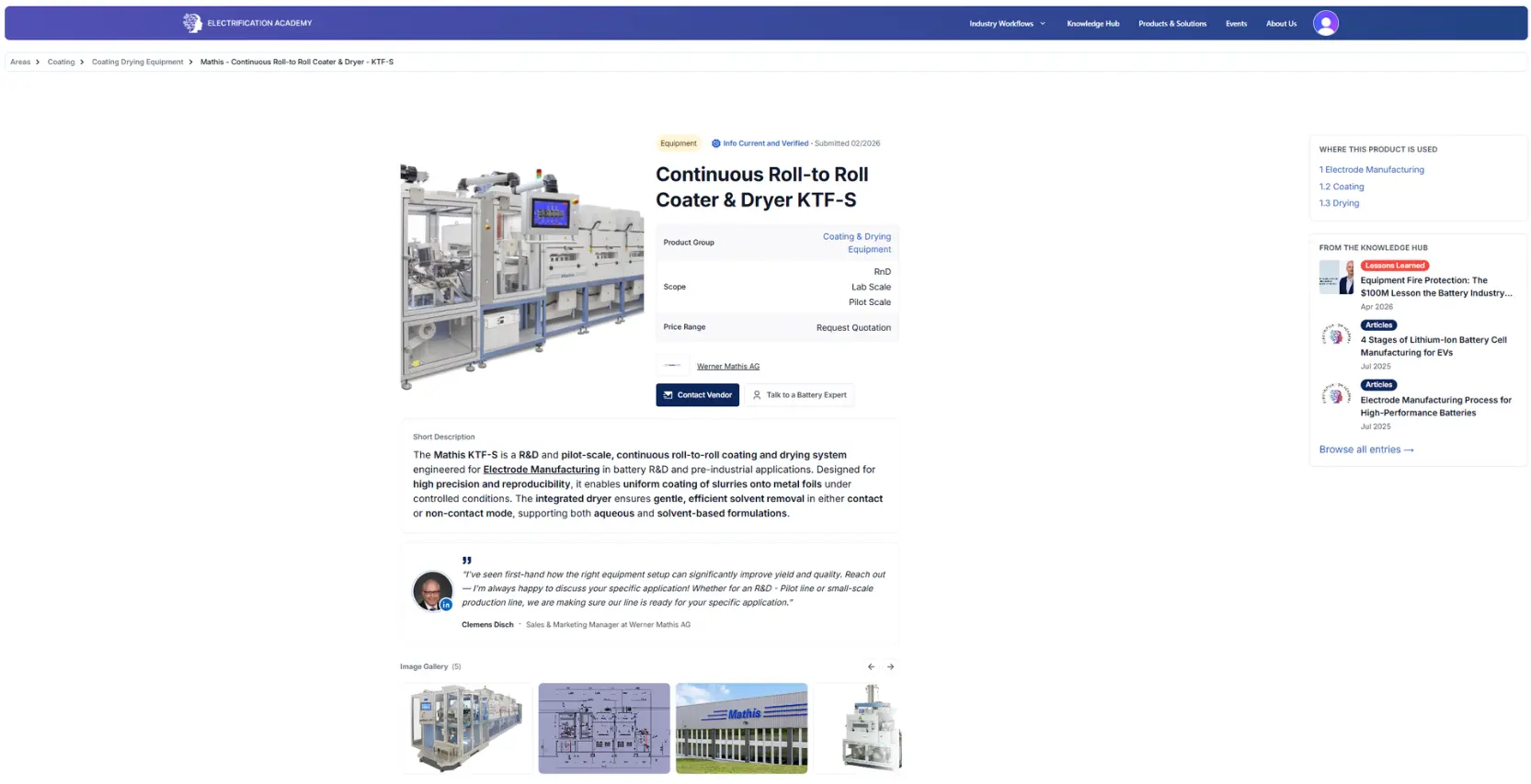
Mathis Product Listing on Electrification Academy
What I am actively contributing to the platform
If you are working on a battery cell manufacturing project — scaling a pilot, qualifying new equipment, or building out an ITT — these are the areas where my work with Electrification Academy is most directly useful;
 Coating and drying ITT guidance. Helping teams specify coating and drying equipment with the technical criteria that actually matter at invitation-to-tender stage — going beyond throughput numbers to integration, control and quality realities. (Live on the platform shortly.)Electrode manufacturing fundamentals. The upstream choices — slurry rheology, coat-weight, calendering, drying profile — that downstream cell performance depends on. The decisions made here echo through the entire factory.Vendor and equipment due diligence. Evaluating suppliers against real workflow needs rather than spec sheets alone — what the equipment actually does on day 90, not what the brochure says on day 1.People, process and technology integration. The unglamorous bit that decides whether a promising pilot line becomes a scalable production environment — and the bit that gets cut from most vendor conversations. See also: digital transformation rarely fails because the software is bad.
Resources on the Electrification Academy platform
If this post leaves you with a specific question to chase, start in the area of the platform closest to your problem:
Battery Cell Manufacturing area — workflow-first navigation across mixing, coating, drying, calendering, slitting, assembly, formation and module integration.The Electrification Academy platform — vetted vendor ecosystem, expert network and knowledge base across the battery and electrification value chain.Electrode coating and drying equipment guidance — ITT-stage criteria, integration considerations and vendor due-diligence support. (Dedicated landing page going live shortly.)Expert network — independent subject matter experts across battery cell manufacturing, recycling and the wider electrification ecosystem.Vendor partner ecosystem — equipment suppliers and solution providers organised by process step and workflow rather than category.Scaling a battery cell manufacturing programme?
If you are qualifying coating and drying equipment, building an ITT, or trying to make sense of the vendor landscape across cell production — Electrification Academy is the right starting point. If you also want that thinking brought into a broader digital and manufacturing integration conversation, TJ Digital Systems is one call away.