Unlocking Digital Manufacturing: The 40-Minute Version
At Digital Manufacturing 2Day at the MTC, we presented a way to find out where manufacturing companies really are, a business case, and a roadmap to adopt.
On 13 October we stood up at the MTC in Coventry with Max Abenthum of CONTACT Software and asked a full room one question: so, how do you unlock digital manufacturing? It may sound simple, but you need to understand several aspects first. Where are you today? Where do you want to be? What is the plan? And how do you deliver it?
The audience were given two points of view on purpose — Tim Shelley from the manufacturing shop floor, Max from the software and solution side.
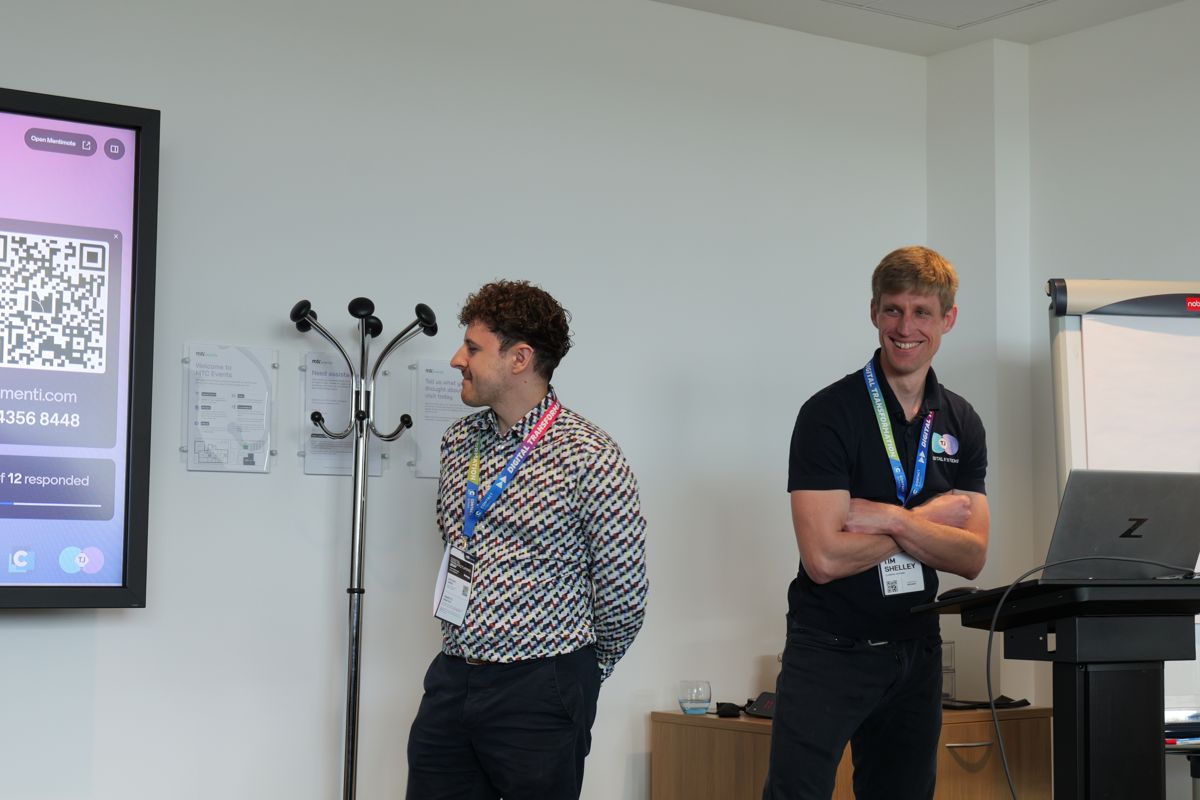
Two views, one stage — MTC Coventry, 13 October 2026.
What we see out there
Between us, we have watched digital projects from two very different seats — Max across Germany, Asia and the US; Tim on the manufacturing shop floors in the UK. We keep seeing the same five things. Nobody can tell us what they want: no requirement, just a feeling. A modest budget carrying a Rolls-Royce expectation, because software is seen as cost rather than value. The machine gets bought first and someone asks how it connects later — by then it is on the floor, and yours. The software is expected to fix the process, so the same process simply runs faster, and now it is more expensive. And nobody owns any of it on the Tuesday after go-live — a budget, a date and a steering committee are not ownership.
That is the honest version, before anybody has sold anybody anything. Every one of those five is avoidable, and the four questions exist to avoid them.
Where are you today?
Before any roadmap, you need honest scores, and you can get them without spending a penny. Put six people in a room for half a day: someone who runs a shift and is on the floor when it goes wrong at 2am; a process engineer who knows why the settings are set; quality, who has to prove it afterwards; whoever owns the systems, usually one overworked person in IT; someone senior enough to say "Yes" in the room; and finance — the one everybody leaves out, and the one who decides whether anything gets funded. If those six cannot agree on what is happening today, no software will make them agree. It will just give them a more expensive place to disagree.
To score, we use the Smart Industry Readiness Index — SIRI. Built in Singapore in 2017 by the EDB with TÜV SÜD, run with the World Economic Forum since 2020, governed today by INCIT, a neutral not-for-profit. Thousands of plants assessed in more than 60 countries. Sixteen dimensions across process, technology and organisation, each scored 0–5 on the same bands, so the result is comparable plant to plant and year to year. The reason we use somebody else's framework rather than our own is simple: it is independent of any software or hardware supplier — including both of ours.
One rule we insist on: score the bad week, not the good one. The most common reason an assessment produces nothing is that somebody scored the place on a good week.
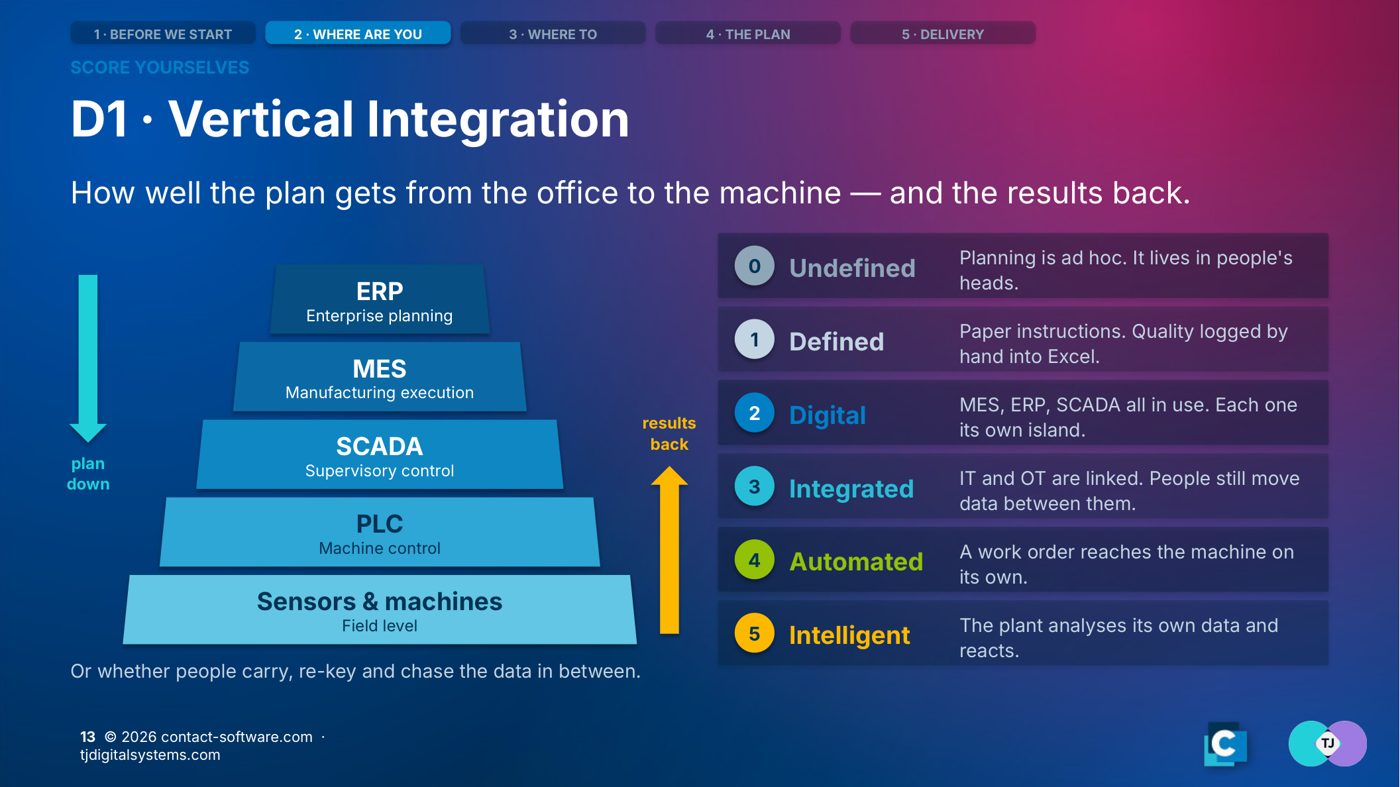
D1 · Vertical Integration — the automation pyramid, and the six bands the room scored itself against.
What the audience see
We didn't just describe the assessment — we ran two of the sixteen dimensions live, on the audience, through Mentimeter. Thirty-one people took part.
On Vertical Integration: how well the plan gets from the office to the machine and the results back — eleven of twenty-four put themselves at band 2, "Digital": MES, ERP and SCADA all in use, each one its own island. Only four scored themselves "Integrated", and nobody picked "Automated". On Integrated Product Lifecycle: whether design, production and service work from the same product record, the picture was almost identical. Eleven of twenty-one at "Digital", with a thin tail above it.
That is the finding of the day: a room full of manufacturers who care enough about digital to give it forty minutes of a busy show, and the biggest group describe themselves as digitised but not connected. The systems exist. The islands are real. The data still travels between them in people's hands, carried, re-keyed and chased. If that describes your plant too, you are in the same position as most of the people who were in the room.
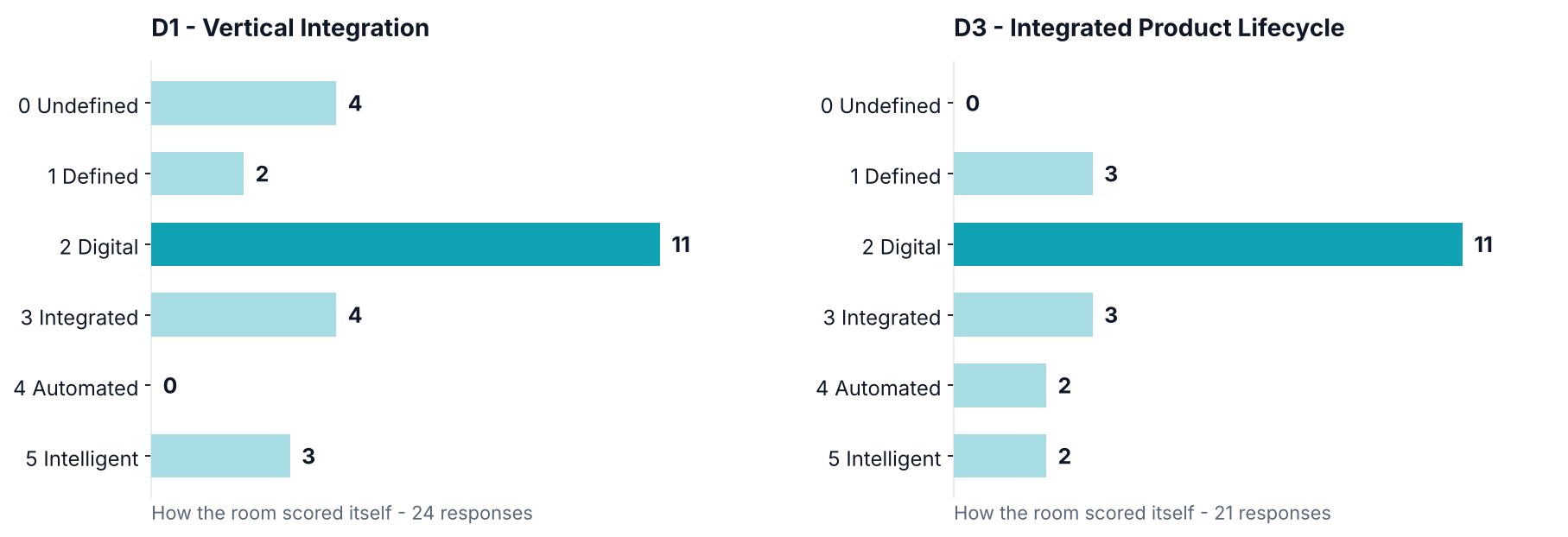
The live scores — 31 participants, both dimensions clustering at band 2, "Digital".
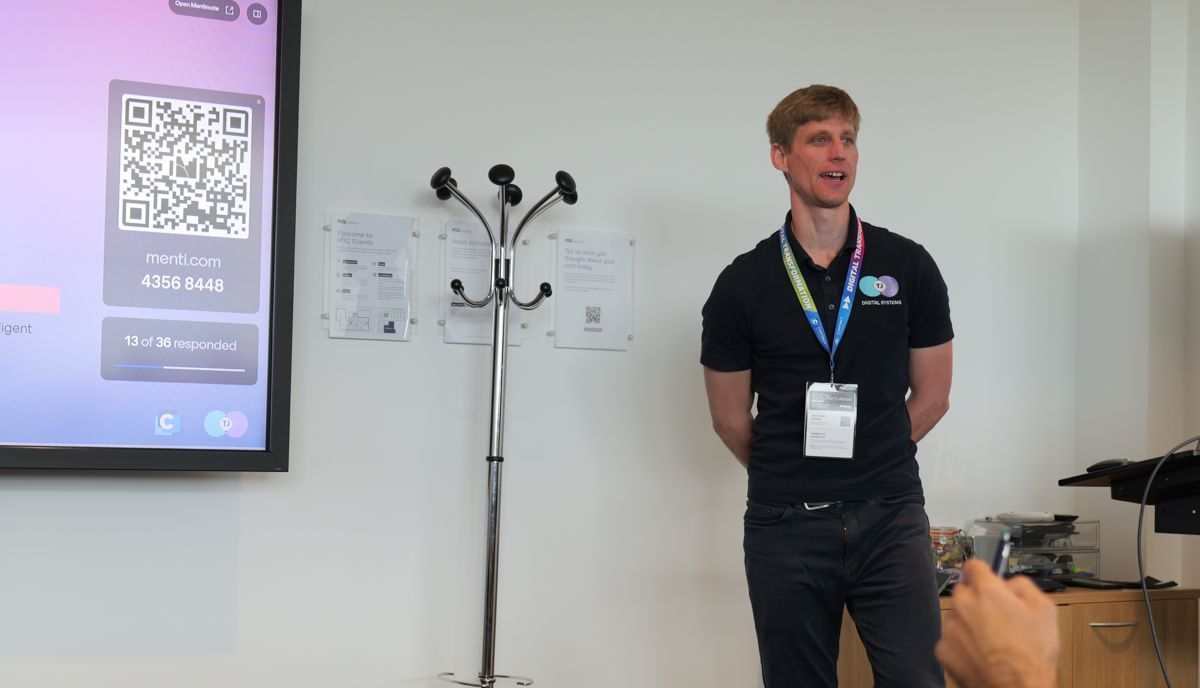
Scoring live in the room.
The business case
Everybody has been asked for a business case, and everybody knows the sinking feeling: go away and build a spreadsheet. You do need the payback number — it is vital — but on its own, it is the easiest piece of the argument to pick apart, because every assumption in it is yours. The case that actually gets signed rests on three numbers the business already recognises: the cost of today, the risk you carry, and what one step up unlocks.
Here is the sum you can do in your own business this week, in about four minutes. Say twelve engineers lose an hour and a half a day looking for information — the drawing, the revision, the job status. Twelve, times one and a half, times 220 working days: just under 4,000 hours a year. That is more than two people, full time, all year — people you have already hired, already trained and are already paying — looking for stuff.
And sometimes the case is shorter still. Max's favourite came from the managing director of Kampf, a 650-person German machine builder whose first attempt at a system had failed: "Orders were increasing. The methods could not carry them." That is the whole business case. When you cannot get work out of the door, nobody asks for a discount rate.
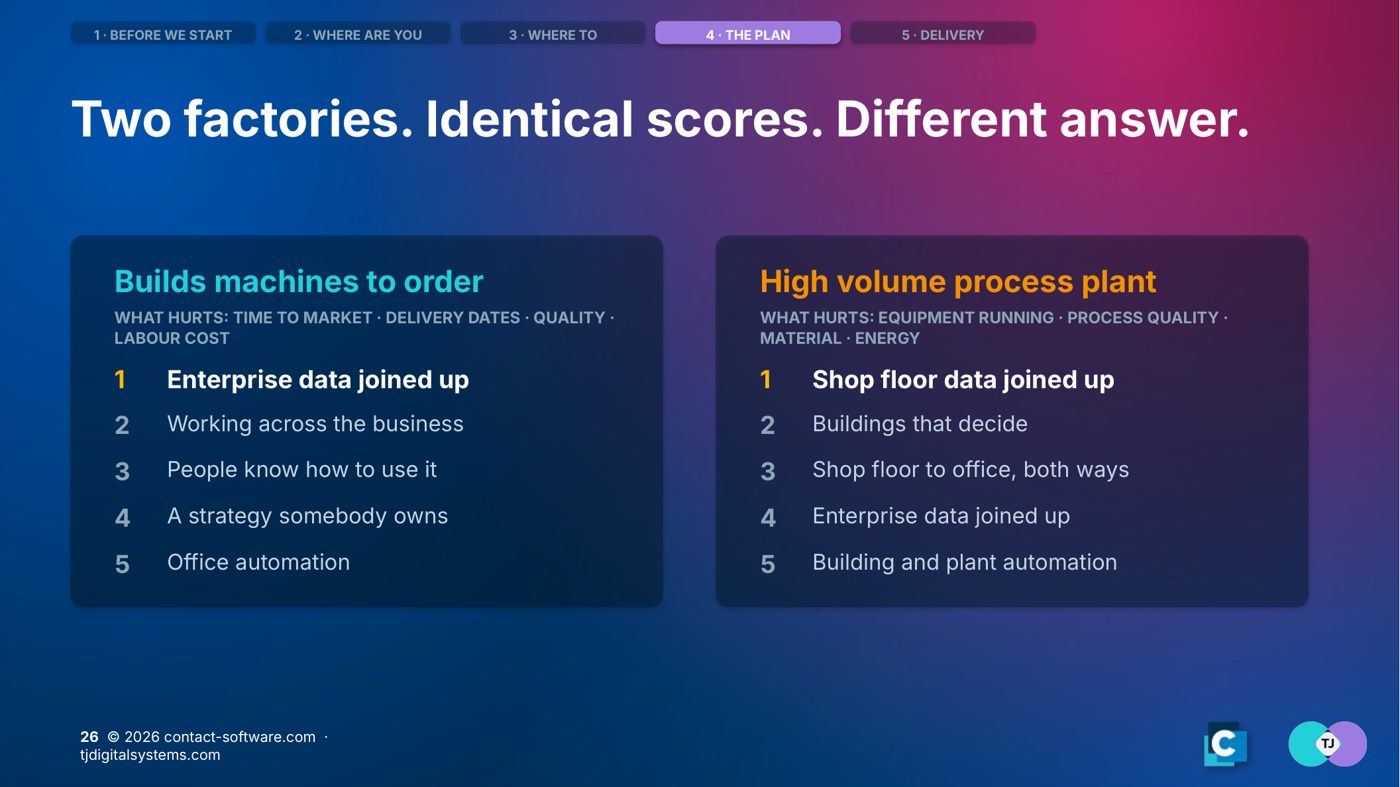
Two factories, identical sixteen scores — and completely different answers.
Not all fives: where the roadmap comes from
Here is where it usually goes wrong, and it is expensive. The sixteen scores come back, there is a row of 1s and 2s, and the instinct is: right, we need to get everything up to a 4. No. Nobody needs a 4 on all sixteen. Some of those rows genuinely do not matter to your business and never will. The real question is: which one or two rows, moved up by one band, change a number your board already looks at?
We showed the room two factories with identical sixteen scores and completely different answers. One builds machines to order, and what hurts is time to market, delivery dates, quality and labour cost, so joining up enterprise data tops its list. The other is a high-volume process plant. What hurts is equipment uptime, process quality, material and energy, so the shop floor comes first. Same maturity on paper; different business; different order. The ranking is not taste: your scores give the size of each gap, your cost profile says what closing it is worth, and the KPIs your board already reports on decide what counts as proof. Plot the result on value against effort and the top-left quadrant is your plan.
Then, think of it the right way round: a series of mini-projects, each one small enough to finish, rather than a big digital transformation programme.
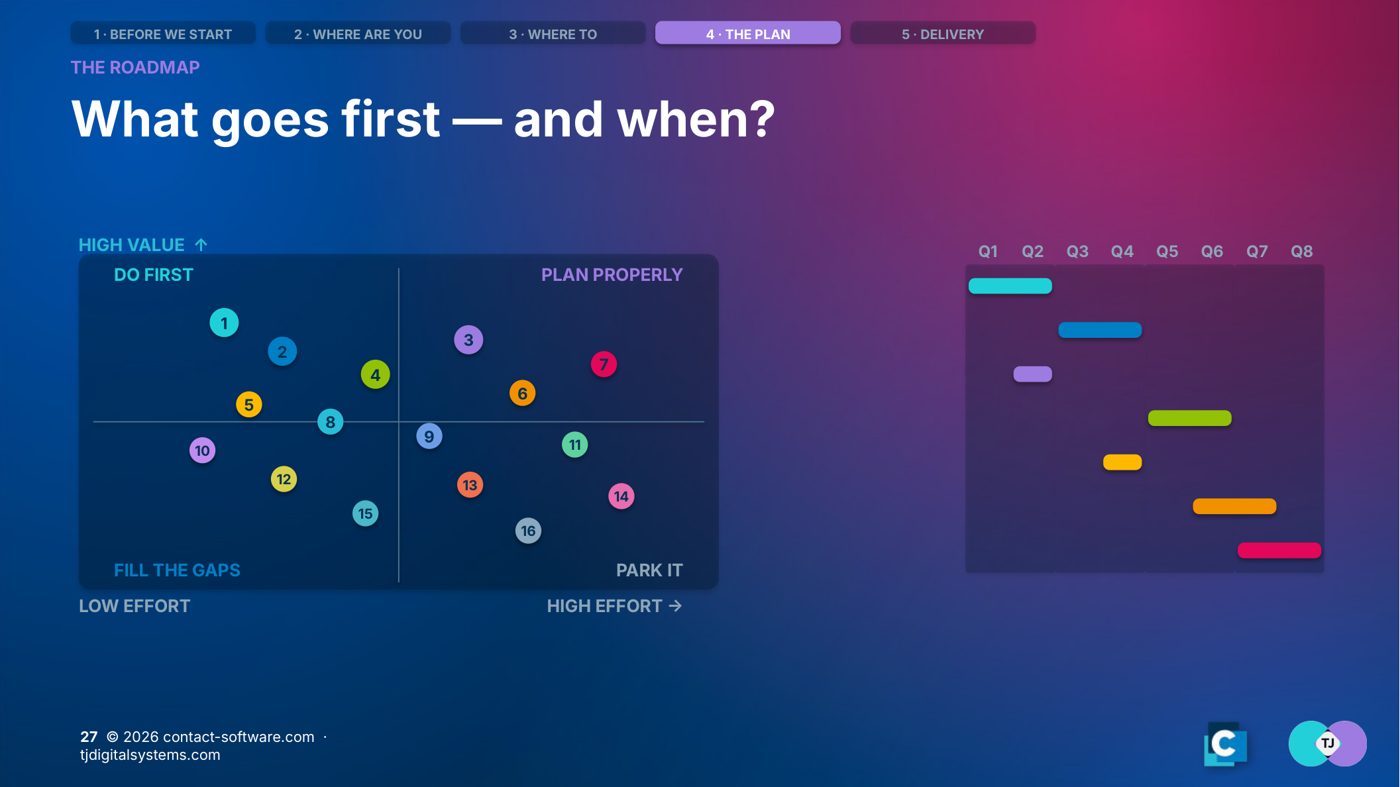
The roadmap — sixteen dimensions plotted on value against effort.
Software is question four, and it was never question one
Go back to any single block on that roadmap and it is never just a software install. It is four kinds of change, in this order: people — who does this job on Tuesday morning, and have they been trained; process — what changes in how the work flows, and who owns the new way; technology — the kit, the connections, the data you can trust; and software, last, once the first three have answers. Max made the awkward point himself: if your people do not use it, it is not software — it is a cost with a maintenance contract.
We also kept our promise to disagree. Max would put the platform in early — every module after the first one is cheaper, and yes, he works for a company that offers that discount. Tim pushed back, from a live scaling project sixteen months in: we did not buy any platform software for the first four or five months — not because it wasn't good, but because the people were not aligned, the processes were not written down, and the data off the machines was not yet real. Both are true. The order still starts with people.
Where we stand
Forty minutes, three promises, all of them free to act on: an assessment you can run with six people you already employ; a business case built from three numbers your board already knows plus one four-minute sum; and a roadmap in an order you can defend. What the room's own scores confirmed is what we see every week — most manufacturers are not short of digital systems, they are short of connections between them, and an agreed order in which to build those connections.
This is the approach we use with people first, then data, then technology on every engagement, and it is why we start with a readiness assessment rather than a product demo.
Delivered with Max Abenthum, Solution Consultant at CONTACT Software, at Digital Manufacturing 2Day, MTC Coventry, 13 October 2026. Customer figures quoted are published CONTACT Software references.
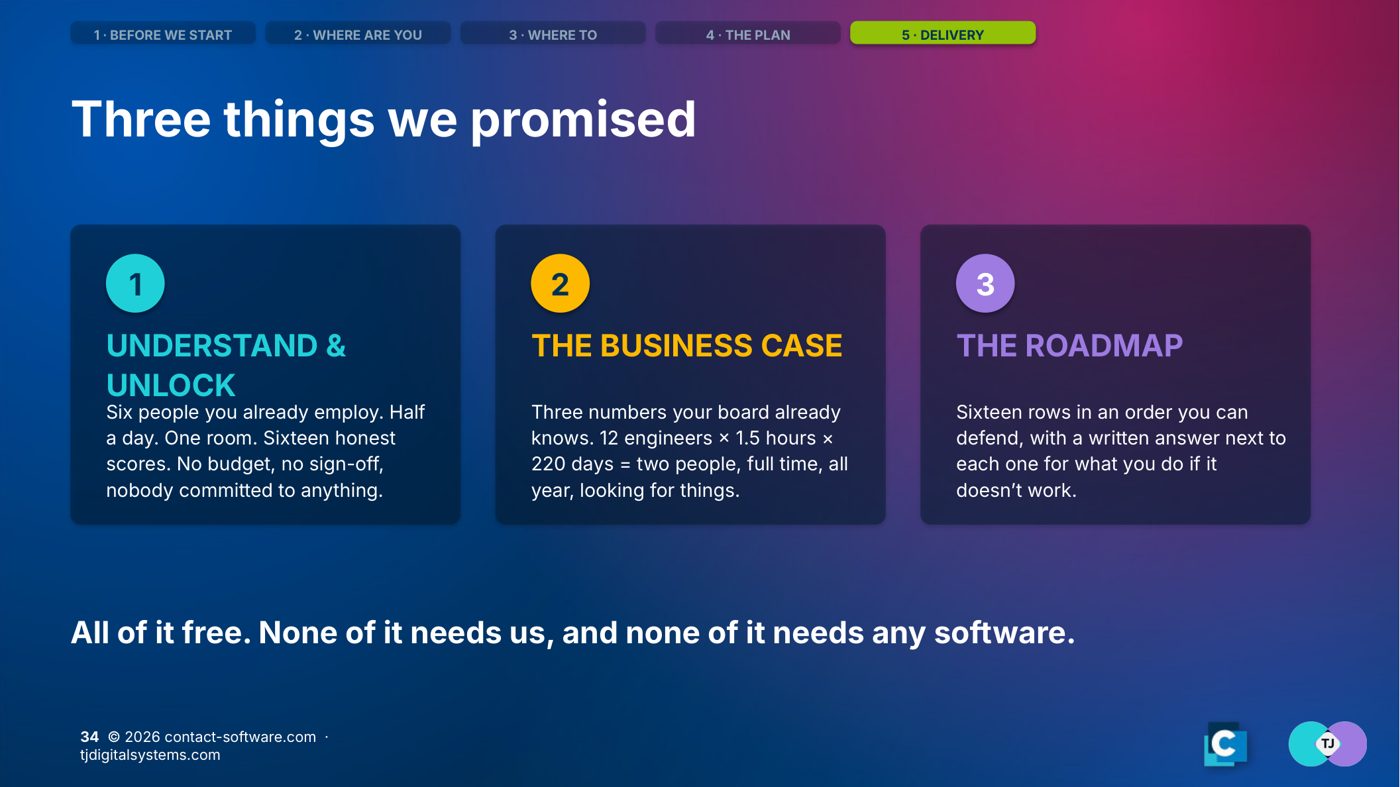
The three promises: all free to act on, none of it needing us or any software.
You are not short of things you could do
You are short of an agreed order to do them in. A half-day readiness workshop at your site — your team, your plant, your numbers — is where that order comes from.